 Efacis
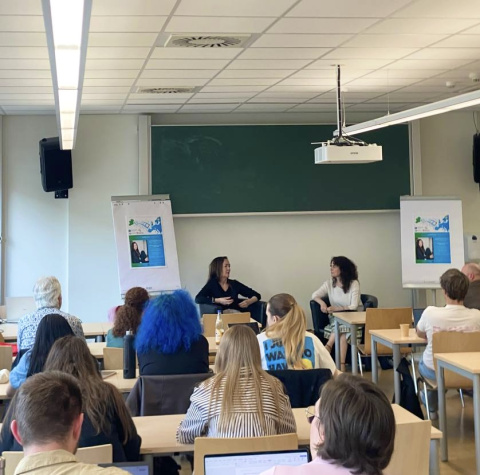
 "This session proved that drama is meant to be heard and felt, not just read, leaving me with a lasting appreciation for Marina Carr."
Katrin Schäfer-Kassin
***
"During the live reading, Marina Carr's tone of voice, pauses, and emphasis revealed how meaning shifts through performance. For example, the way she lingered on certain lines showed how delivery can intensify emotion and shape audience response. Engaging with both classroom analysis and Carr's own reflections deepened my understanding of her work and demonstrated that literature gains meaning not only through analysis, but also through vice, performance, and lived experience."
Sophie Domenig
***
"What stayed with me most after Marina Carr's visit was the way she talked about characters and storytelling. I found it really interesting when she said that, as a writer, you have to love your characters, even the difficult or "monstrous" ones. That idea stayed with me because her plays deal with very dark topics like violence, guilt, death, and trauma, but she still speaks about the characters with understanding and empathy."
Julian Wirtitsch
***
"For me personally it was quite jarring how differently I read Marina Carr's works on my own compared to how she herself read them. So seeing and hearing hte playwright read her own work was a rather big change of perspective for me."
Roxanne Seunig
***
"Meeting the Irish playwright Marina Carr was a memorable experience for me because it made literature feel much more direct and personal than in a usual classroom setting. Hearing her speak about her own work made the plays feel much more personal and real. One idea from the discussion that stayed with me most was when she explained that writing often starts with a small image, feeling, or voice in her mind instead of a full story. This surprised me because I had always thought writers carefully planned every part of a play before they started writing. Carr showed that writing can be emotional and natural, and that stories sometimes develop on their own while you are writing."
Emily Dundacek
***
"During the event and discussion, Marina Carr read from several of her works, including The Boy, Girl on an Altar, and Woman and Scarecrow. Listening to a playwright talk about their own works and read them out loud is, for me, somewhat of a surreal experience."
Aleksandra Dovžan
***
"Listening to Carr discuss her creative process made the work feel more alive and human, while also deepening my appreciation for the emotional and artistic complexity of contemporary theatre."
Dana Wohein
***
"I was immensely impressed by this meeting and found it very beneficial. Both the readings and the discussion were of great interest to me and brought a few ideas which I would love to explore."
Anna Demidova
***
"Attending the reading and discussion session with Marina Carr gave me a deeper understanding of her plays than I could have gained just by reading them. What stayed with me most was when carr said that 'the drama is common' and spoke about how love, cruelty, tenderness, and pain can all exist in the same relationships. Overall, the event gave me both a stronger emotional connection to her work and a greater appreciation for theater as a live art form."
Gabriel Kohlmaier
***
"Marina Carr's visit helped me better understand theatre as a collective experience. she described theatre as a place where 'we are all watching something together', and this idea became very clear during the event itself. Overall, the visit showed me that literature becomes much more alive when it is performed and shared with others."
Valentina Starc
***
"Experiencing an author passionately talking about their work was exactly what I had hoped it would be: eye opening and 'feelable'."
Judith Zedrosser
***
"I want to express my gratitude to be able to experience this event. It was an absolute pleasure and very refreshing. it is safe to say that everybody was enjoying this live reading of Carr's plays very much. Seeing the person that has devoted their life to this craft act out their most treasured works was a new experience for me. It gave a face and voice to the words."
Simon Nagele