 Efacis
 "What stuck with me were Caldwell's concepts of 'emotional research' and 'emotional bravery'. She prefaced that before writing These Days, she felt a responsibility to tell the story as accurately as possible, especially because there is currently very little fiction about the Belfast Blitz. While she views it possible to write stories about experiences that are not your own, research of a city and its people were essential to her writing process. What surprised me is that this emotional aspect of Caldwell's research allowed her to connect joyful stories to a narrative which is otherwise characterised by victimhood. This I think underlines that what is seen as relevant societally are 'grand narrativs' or eeasily generalisable information, but Caldwell's work, which is individual and includes contradictions - moments of joy in a period of chaos and loss - resists this in a powerful manner."
Olivia Fischer
***
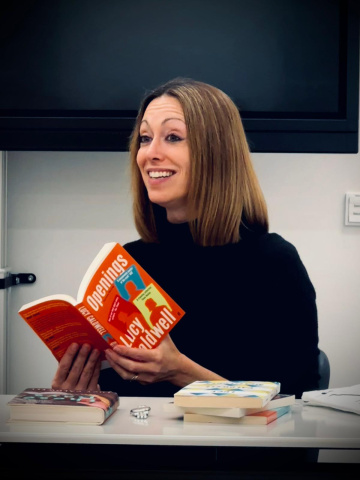
"We had the privilege to meet with Lucy Caldwell for a short reading of her book These Days, as well as her short story 'Unter den Linden'. The session also allowed us to ask questions, which proved very insightful for our understanding of the texts and Northern Irish fction as a whole and how it links with memory.
Emotion is blended into the novel These Days through Caldwell's descriptive prose, despite being, in many ways, a historical novel which follows real-life events (Belfast Blitz). Caldwell mentioned that, no matter how objective you try to write a novel like this, your own imagination, experience, and thus emotions factor in in some small ways. The chapter about Betty is emotional of course, and reinforces the last point Caldwell made to us which is that she cared more about feeling rather than plot when writing this novel (or any novel). the use of this character is a personification for Belfast and thosse lives lost during its often overlooked war period. But the function of this elegy specifically, as Caldwell told us, is the use of words "to bind a grief in", or also "a way to keep it [the memory] safe."
Matthew Leavy